
ARCHITECTURE:
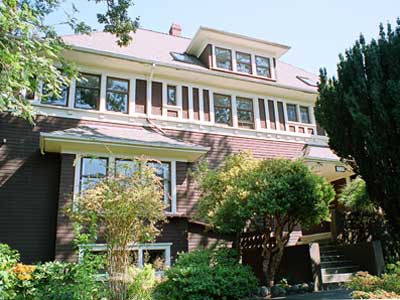
Clairden is an asymmetrical 2½-storey, Tudor Revival Arts & Crafts house. It is bellcast-hip-roofed and has three flat-roofed and one hip-roofed dormers. There is a two-storey wing on the right side with a one-storey, hip-roofed bay on the main floor to which a flat-roofed entry is attached. The left rear has a long extension and several one-storey box bays. The left side of the house has a full-height box bay towards the front. The front façade has a full-height, shallow, hip-roofed box bay to the right of the recessed main entry porch. There is a hip-roofed canopy over the exterior portion of the porch, which has front-facing stairs offset to the left. To the left of that is a deeply hip-roofed box bay. A high belt course separates the stucco and half-timbered upper level from the shingled main floor. The shingles extend to the low water table over the concrete foundation. The concrete-capped stone terrace in front of the house, which bordered a garden, now borders a driveway. It was built for $18,000 and the 1922 alterations were for $900.
ORIGINAL OCCUPANTS:
1911-18: Simon Leiser (b. Kerpen, GER 1851-1917), one of Victoria’s pioneer merchants, came to Wisconsin in 1868 where his uncle Jacob Lenz was an established wholesale liquor dealer. By 1872 Simon was managing two stores and the Chicago office of his uncle’s business. He met Jacob’s daughter Caroline “Carrie” (b. Milwaukee, WI, USA 1855-1935) who came here with him in 1873. After a brief stint in the coffee business, he headed for Cassiar District, BC and won a contract to build a 100 km trail from Telegraph Creek to Dease Lake. During this period he opened his first grocery store with Jacob Lenz, and during the later 1870s operated four stores which catered to the many miners in the region. He returned to Victoria in 1880 and established a grocery business on Johnson St; its success prompted him to enter the wholesale business as Simon Leiser & Co in 1894. In 1896 he moved the business to 522-524 Yates St (Downtown) the block that bears his name. The largest wholesale grocery business in BC during the 1890s, it employed about 100 people on Vancouver Island alone, and extended E into the Kootenays and N to Alaska. It was particularly prosperous in the 1890s during the Klondike Gold Rush. He expanded into the sealing trade, eventually becoming director of Victoria Sealing & Trading Co. The seizing of his boats Wanderer and Favorite by the US Government in 1894 precipitated international negotiations that ended pelagic seal hunting in the Pacific in 1911. [He was also pres of Burridge Mercantile Co].
An active member of Board of Trade, Simon became pres in 1909 and during his two terms, he promoted the building of Victoria, particularly the Inner Harbour. His other interests included Royal Jubilee Hospital (RJH), Victoria Opera House and Royal Theatre. A Mason, he was a member of Vancouver-Quadra Lodge, No. 2 AF&AM. In May 1915, the night after the German navy sank RMS Lusitania (13 Victorians died, including 21-year-old Lt. James “Boy” Dunsmuir, scion of the Dunsmuir family), angry crowds rioted downtown, ransacking buildings and businesses owned by German-born citizens. Two of Simon’s buildings on Yates St were badly damaged and stock looted.
Simon died at his daughter’s residence in Vancouver. Son Herbert Leiser (b. Victoria 1885-1953) lived in this house in 1918 with his mother, Carrie, who in her youth was a noted pianist. She was engaged in various philanthropic activities, including Aged Women’s Home, Women’s Auxiliary of RJH.
OTHER OCCUPANTS:
1919-22: George Gordon Bushby (b. Victoria 1869- 1932) and Violet Carlotta (née Brae, b. Sheffield, ENG 1876-1955) married in Calgary in 1908. Violet came to Canada in 1892. George was the grandson of Sir James Douglas and the son of Arthur Thomas Bushby, an accomplished musician and key political figure in BC’s early history. George studied engineering in England and San Francisco and began his career with his sister, Annie Bushby Bullen, her husband William Fitzherbert Bullen and his brother Harry Frederick Bullen (1007 Joan Cr, Rockland, 906 & 908 St. Charles St) as a partner in the BC Marine Railway Co. George established a branch of the firm in Vancouver in 1898, and stayed there until he sold his interests in 1919. The Bushbys bought this house for $50,000 and lived in Victoria for several years, then moved to Prince Rupert in 1921. George established Rupert Marine Products, a fishery production plant, and operated the facility for 10 years until ill health forced him to retire.
1922-28: Elliott Torrance Galt (b, Sherbrooke, QC 1850-1928) was one of 13 children of Sir Alexander Tilloch and Amy Gordon Galt, and the brother of John Galt (1320 Rockland Av) who retired to Victoria in 1920. Alexander, Canada’s finance minister in 1868, was a Montreal businessman. In 1879–80 Elliott travelled the prairies as assistant to Edgar Dewdney (1759 Rockland Av), Indian Commissioner for Manitoba and the Northwest Territories. With his father, Elliot opened the first large coal mines in southern Alberta, and established the town of Lethbridge. Elliott was responsible for turning a large portion of Alberta’s native praire into productive agricultural land. In 1903 he became president of Alberta Railway & Irrigation Co, which combined the family’s mining, irrigation and railway interests. In 1912 the CPR bought them out. Elliott later made his home in New York, where he died in 1928. Lethbridge has honoured him by naming their museum the Galt Museum and Archives.
1922-59: Selina “Lena” B. Galt (b. Sherbrooke, QC 1863-1959) and Muriel Grace Galt (b. Sherbrooke 1873-1939) came to live with their unmarried half-brother Elliott, Inheriting the house when he died. Lena remained until her death.
1959-60: Clairden was converted into the 10-suite St. Charles Lodge Apts for $8,500 by John Franchetti.