ARCHITECTURE:
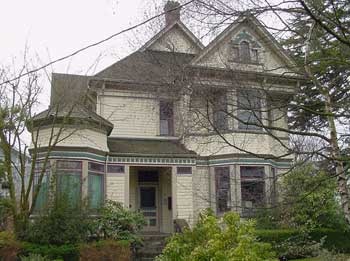
This house was built for the Gonnason family, who lived here until the late 1930s. It is a handsome 2½-storey example of late-Victorian Queen Anne Revival style, featuring a wealth of brackets, mouldings and other details as befitted the home of the co-owner of one of the City’s major millwork and moulding manufacturers.
The main roof is gable on hip, with pedimented gables on each of the four sides: these gables all have round-topped windows, the front one having a Palladian set. The front and south side gables crown large 2½-storey extensions with octagonal bays jutting out from the centre of the flat outer walls. There is drop siding on the first and second floors, separated by a wide bellcast belt course of scalloped shingles. An octagonal pepperpot turret on the front left corner has a shallow hipped roof above a continuation of the shingled belt course of the main walls. There are later additions on the back end, including an elaborate stair system to upper suites. Coloured and textured Queen Anne glass surrounds the upper panes of many of the double-hung windows. The foundation is brick, as are the three handsome corbelled chimneys. Curved granite is used for the front steps, with granite and concrete balustrades. The front porch has been partially filled in, possibly a relic of the Tudorizing and A-frame entrance from some earlier decade. The house was converted to four suites in 1943, from plans by architect D.C. Frame. In 1981, the owners received a Hallmark Society Award for their restoration of the exterior.
ORIGINAL OCCUPANTS:
1990-38: Benjamin Gonnason (1854-1938), born in Stockholm, Sweden, and raised on the family farm, came to North America with his mother in 1872 to join his father who had arrived earlier in Kansas, to escape bleak farming conditions in Sweden. Benjamin married Anna Colling (1856-1919), a fellow Swede, in 1882. They moved to Seattle in 1883 with Benjamin’s brother Aaron, and the brothers worked in a sash and door factory for one year.
The Gonnasons arrived in Victoria in 1884, and the brothers continued the same line of work for seven years. In 1891, they established Capital Planing Mills, later known as Lemon, Gonnason & Co, in Rock Bay at the corner of Store and Pembroke with Joseph James Lemon, who ran the office; they employed 20 men. In 1903 a sawmill was added early in a period of tremendous economic expansion. Lemon, Gonnason specialized in sash and doors and fine interior finishings, and supplied materials for many of Victoria’s well-known buildings, including the Empress Hotel (721 Government St), the Sayward Building (1201-13 Douglas St) and the Pemberton, now Yarrows, Building (637 Fort St), all Downtown. Five years after the death of Joseph Lemon in 1915, Herbert F. Crowe, Aaron’s son-in-law, joined the firm and the name was changed to Crowe, Gonnason & Co. Benjamin and Aaron died five days apart in 1938. The firm continued to flourish until an economic downturn forced it to close in 1958. The vacant sheds burned down in 1960.
1940-43: Northwestern Creamery President Francis Herman Anthony Norton (b. Saltspring Isl 1884-1959) and Laura Sophia (née Nordquist, b. Minneapolis 1886) were married in Victoria in 1910. Francis founded Northwestern in 1912 with Arthur G. Snelling (1872-1934). Francis’s parents were from two of the earliest groups of settlers on Saltspring: John Norton, Portuguese from Pico Island in the Azores, and Annie Robinson, a Black woman from San Francisco.
1943: For $4,000, the house was converted under the NHA into four apartments, architect D.C. Frame, contractor V.L. Leigh.