
ARCHITECTURE:
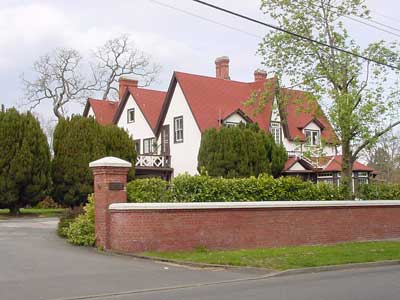
Duvals, the oldest surviving house in Rockland, today demonstrates the changing tastes of the last 150 years. Originally a Gothic cottage on Belcher St, later called Rockland Av, it was greatly expanded 50 years later.
The original cottage, whose front faced E, was 1½-storied and steeply-cross-gabled with an extremely steep through-the-cornice wall dormer on the left side and an angled bay with a flared peaked roof in the front gable. There was a wrap-around balcony on the upper floor above a wrap-around verandah, both with stickwork balustrades. The verandah and balcony are reminiscent of the contemporary Wentworth Villa, 1156 Fort St. The verandah had a wide angled bay to the left of the main door. There were two corbelled, split-stack brick chimneys and one wide, panelled brick chimney.
By the 1900s the upper balcony had been removed and replaced by a hipped roof over the still-existing parts of the verandah. A gabled roof was added over the far right side of the verandah. In 1910 Harry Barnard had James & James modernize and expand the home. They reversed the house, making the W façade the front, where a porte cochère was constructed. They added a 1½-storey extension creating a third gable on that side. In 1914-15, C. Elwood Watkins designed the deep angled bay on the SE side which is the dining room. Photographs indicate that between 1948 and 1977, the open porch on the south was filled in and through-the-cornice wall dormers were inserted in the roof, possibly during the 1954 conversion to five suites. A pedimented gabled entry porch was added between the enclosed porch and the dining room bay, with a small balcony above. The house is now stuccoed.
ORIGINAL OCCUPANTS:
1860-65: John Miles (b. York Factory, MB 1825-1861), a clerk and accountant under Col. Richard Moody, RE in 1859 and Elizabeth (née Meeson, b. Thurrock, Essex, ENG 1819-1900) married 22 Jan 1861 and sadly, at age 35, he died two days later. He had been an active member of Union Hook and Ladder Company. Elizabeth was only in Victoria a short time before her marriage. She bought Cary Castle (1401 Rockland Av) in Jan 1865, sold it in April to Gov Arthur Kennedy and it became the first Government House. In 1869 Elizabeth moved to Sooke where she taught for a few years at Sooke School. She then travelled back and forth between here and San Francisco, eventually settling there.
OTHER OCCUPANTS:
1865-70: Sir Joseph Needham (b. ENG 1812-1895), wife Jane (née Fraser b. Mddx, ENG 1814-1900) and daughter Selina Maude (b. Paddington, ENG 1850-1942) came in 1865 when he was appointed chief justice of Vancouver Island. They entertained at this rural cottage, and visited neighbouring Cary Castle for various high society events. When Vancouver Island and mainland colonies joined in 1866, there were two supreme courts for three years. Judge Matthew Baillie Begbie (1041 Collinson St,) was chief justice of the mainland, and conflict arose between them. Needham resigned in 1870, was called to serve as chief justice in Trinidad, West Indies and was knighted for his services. He retired in 1886 and returned to England.
1870-1954: Francis Jones Barnard (b. Québec City 1829-1889) married Ellen (née Stillman, b. IRL 1825-1889) in 1853 and they moved to Toronto. Francis began in the family hardware business. In 1859 he left his family and travelled via Panama and San Francisco to BC to seek his fortune in gold. He staked a claim in Yale, sold it for a small profit, became a constable, then a purser, earning enough to bring his family to BC.
In 1860 Barnard established his first express mail service carrying letters on his back from Yale to the Cariboo Gold Rush, a 760-mile round trip, on foot. He earned $2 per letter, and sold newspapers for $1. In 1862 he began a pony express. Large amounts of gold were being transported to Victoria and he gained a reputation for reliable and secure delivery. In 1862 the government began building the Victoria wagon road from Yale to Barkerville, and he established Barnard’s Express & Stage Line, “the BX Express,” equipped with 14-passenger, six-horse coaches. He expanded in 1864 and bought out Dietz & Nelson (who ran from Yale to Victoria) in 1866, giving him a monopoly over the entire route. Steve Tingley (1564 Rockland Av), a driver who became his partner, bought out Barnard in 1886 and renamed it the BC Express.
The Barnard family moved from Yale to Victoria in 1868, and to Duval Cottage in 1870. He served as MLA for Yale 1866-70, and Yale-Kootenay 1879. He took road steamers (like railway steam engines) to the Cariboo in 1870, but they were ill adapted to treacherous wagon roads and the business failed. In 1874 he won a contract to build 700 miles of a transcontinental telegraph line from Fort Edmonton to Cache Creek. He bought the equipment, but the route was changed twice, delayed, then cancelled in 1878 causing a major financial loss. A stroke in 1880 left him an invalid until his death.
The Barnards’ offspring: Alice Telfer Barnard married John Mara in 1882 and they later built 750 Pemberton Rd on family property north of Duvals.
Sir Francis “Frank” Stillman Barnard (b. Toronto 1856-1936) married Martha Amelia Sophia (née Loewen, Victoria 1865-1942) here in 1883. They lived at Senator George Henry “Harry” Barnard (b. Victoria 1868-1954) lived at Duvals most of his life. He attended Rev. Cridge’s school, then Trinity Coll in Port Hope, ON. He returned at 16, and entered the law offices of Eberts & Taylor. Called to the BC bar in 1891, he later founded the law firm Barnard, Robertson & Heisterman. In 1895 he married Ethel Burnham (née Rogers, b. Peterborough, ON 1871-1961) and they moved into Duvals. He represented James Bay on Victoria City Council 1902-03, and was mayor of Victoria in 1904-5. He was first president of the BC Liberal-Conservative Assoc in 1908. He was Victoria MLA 1908-17, then was appointed to the Senate. He retired in 1945. [In 1911-12, Bill and Lorinda Bowser lived with Harry and Ethel Barnard while the Bowsers’ new home at 1001 Terrace Av was being built.]