
ARCHITECTURE:
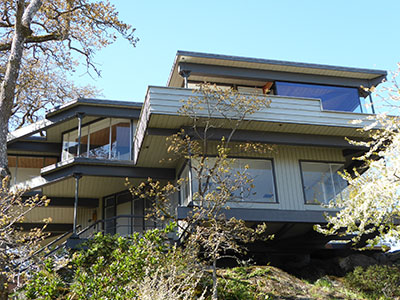
Although a good number of interesting modern houses are evident throughout Greater Victoria, the City itself, largely built up by the 1940s, has only a handful of distinctive post-war houses, all the more valuable for their rarity. Sited on a rocky knoll at the east end of Rockland, this home is arguably one of the finest post-and-beam, West Coast-style houses in the area. Built in 1957, this residence presents an innovative display of structural expression. A reinforced concrete foundation core is anchored to the rock, while a heavy glue-lam beam system projects out forcefully from the house, with the thrusting outer spans of the beams supported on steel pipe columns. The floor and roof decks are fashioned from a 3×8 tongue & groove system. The form of this unique structure is arrayed in a spiraling asymmetry, with dramatic overhangs of beams and cantilevered decks. Windows are large panels of plate glass with mitered corners, which act to emphasize the free-form, floating appearance. Set into a grove of mature Garry Oak trees, the house itself is a kind of abstract architectonic tree.
*Chris Gower from nomination for City of Victoria Heritage Designation.
ORIGINAL OCCUPANTS:
1958-76: Walter Campbell Thomson (b. Victoria 1927-2010) married Mary Ann (nee Hall) in 1955. A structural engineer, he designed many BC Govt bridges. He was a recreational sailor and an eclectic collector.
OTHER OCCUPANTS:
1976-85: Ian and Doreen Appleton co-owned The Cobbler shoe store; Doreen was an RN and BC civil servant.
John A. Di Castri (b. Victoria 1924-2005) ** was a highly individualistic architect. Hired at the age of 16as an apprentice at the BC Department of Public Works, he then articled with Henry Whittaker, BC DPW Chief Architect. At the age of 25, after a brief stint in the office of Birley, Wade & Stockdill, he left Victoria to study at the University of Oklahoma under Bruce Goff, Frank Lloyd Wright’s maverick protégé. He returned to Victoria in 1951, and throughout his career remained dedicated to expanding his interpretations of Wrightian forms and was a key figure in establishing modern architecture in his relatively small and conservative native city. Although there are many good examples of Di Castri’s dependably creative residential projects throughout Greater Victoria, there are actually only three or four other Di Castri house designs within City of Victoria limits. The Thomson House is probably the most visible and prominent. In 2002 this became the first post-1950 house to be designated in the City of Victoria.
**Donald Luxton, The Trend House, Saanich Heritage Structures, 2008