
ARCHITECTURE:
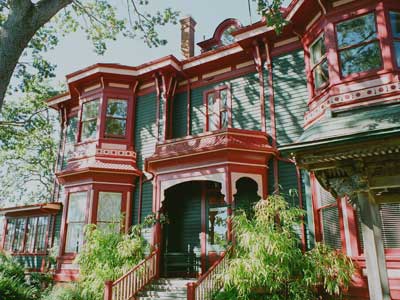
This was once a tall, noble multi-hip-roofed Italianate Villa, standing in a dominant position on the hill, crowned with stately chimneys and a great rooftop lantern. A porte-cochère and a conservatory with a tiny octagonal tower on the front façade are now missing, as is the wrap-around verandah on the left side and rear. Also gone are the generous gardens, tennis courts, coach house and stables.
A number of drastic alterations and additions have been made since 1951 to accommodate the art gallery. The main entrance, and what was once the porte-cochère on Moss St, is now a glass-and-concrete gallery lobby; the pedimented gable over the entrance remains. The symmetrical garden façade on the left side is still intact, including a centrally-located palladian dormer on the roof. A pair of two-storey angled bays are separated by an angled porch below a balconet, all with sandwich brackets and other decorative details.Inside, the impressive, dark-panelled, two-storey reception hall with its Minton-tiled fireplace and gallery with Art Nouveau glass is intact. Huge pocket-doors between the drawing and dining rooms are used to advantage for events.
Donald Luxton has described William Ridgway-Wilson as “prolific and surprisingly versatile.” Ridgway-Wilson, who had only arrived in Victoria in 1887, won the commission to design this $44,000 house for a prominent local businessman.This doubtless paved the way to such important assignments as South Park School (508 Douglas St, James Bay) and Schuhuum (1322 Rockland Av), both 1894.
ORIGINAL OCCUPANTS:
1889-97: Prominent businessman Alexander Alfred Green (b. Ixworth, ENG 1835-1891) and Theophila (née Turner, b. Ipswich, ENG 1840-1905). Alexander trained as a doctor, but instead headed to the gold fields of Australia where he made a considerable fortune. He went to USA, CA then NV, and joined Wells, Fargo & Co. He came to Victoria with WF&C in 1873, and he and Theo lived at 39 Birdcage Walk. 1040 Moss was given the name Gyppeswyk, the ancient spelling of her birthplace. He commissioned the domed Green Block, at Broad and Trounce Alley, later home to Victoria Stock Exchange. Alexander was a founding member of BC Protestant Orphans’ Home (1190 Kings Rd).
OTHER OCCUPANTS:
1899-1903: When Cary Castle (1401 Rockland) home of Lt-Gov burned, His Hon. Dr. Thomas Robert McInnes (b. Lake Ainslie, Cape Breton, NS 1840-1904) and Martha E. (née Griggs/Webster b. ON c.1846) moved into the vacant house. Rent was paid to former BC premier and Victoria mayor Robert Beavan (b. Leigh, Staffs, ENG 1836-1920), who paid property taxes until 1903. In 1900 Lt-Gov Sir Henri-Gustave Joly de Lotbinière (b. France 1829-1908) and Lady Margaretta Josepha (née Gowen, b. QC 1837-1904) moved into Gyppeswyk for three years under construction. He served as Lt-Gov from 1900-06. He arrived in New York on SS Robert Kelly in 1850 and married Margaretta in 1856. Sir Henri was Liberal premier for Quebec 1878-79, and a federal cabinet minister 1896-1900. In 1901 they entertained the Duke and Duchess of Cornwall & York, later their Majesties King George V and Queen Mary, at Gyppeswyk.
1903-51: David Evans Spencer (b. Cowbridge, Glam, WAL 1837-1920) came to Victoria in 1862 and in 1867 married Emma Lazenby (b. Yorks, ENG 1842-1934), who arrived here in 1863 on the “bride-ship” SS Robert Lowe. [Emma’s twin sister Eliza married architect John Teague (1902 Cook St)] For many years they lived at 603 Belleville St at Government St, where BC Archives is now located. They had 13 children; three unmarried daughters remained at home – Agnes Evans (1873-1943), Mary Louise (1873-1951) and Sara Ellen (1885-1983). David was active in the Methodist church and served as a City alderman in 1871. He was also interested in music, leading the choir, of which his offspring were members, for many years. The Spencers gave this house the Welsh name Llan Dderwen. Shortly after his arrival, David bought a small book and stationery business from Charles Hayward (1003 Vancouver St), that he sold to Hibben & Carswell. In 1873 he partnered with William Denny and purchased the retail dry goods firm Findlay, Durham & Brodie on Government St. Five years later he established his own department store, David Spencer Ltd, that eventually became the largest in Western Canada. The business, originally in the Arcade Block between Fort St and Trounce Alley, expanded and Spencer bought more property for a four-storey building designed by Thomas Hooper. Known as Five Sisters Block, it was destroyed by fire in 1910. He immediately re-established business in the old Driard Hotel (1151 Broad St, Downtown) and Victoria Theatre, converted into a department store in three weeks. Spencer expanded the business in 1907 to Vancouver. (See 527 Michigan St). David Spencer operated the business until his death in 1920; son Christopher (649 Government St) managed the Vancouver branch, and son Will (1045 Joan Cr) then managed the Victoria store. Will died in 1946 and daughter Sara managed the store until 1948 when the T. Eaton Co purchased the business. David Jr (2906 Cook St) had also worked for the company.
Sara was a noteworthy businesswoman and philanthropist. During WWI she served overseas with Canadian Field Comforts Commission as an Honorary Lieutenant. She was involved with many local charitable groups, including Victoria’s Women’s Voluntary Services, Red Cross and Community Chest (now United Way). She served as president of Victoria Symphony Society and in 1951 donated this house to Art Gallery of Greater Victoria (AGGV).
1951-2021+: AGGV still in residence.